Displaced Palestinians protest as Israeli strikes intensify in Gaza
By News Media House Staff ·
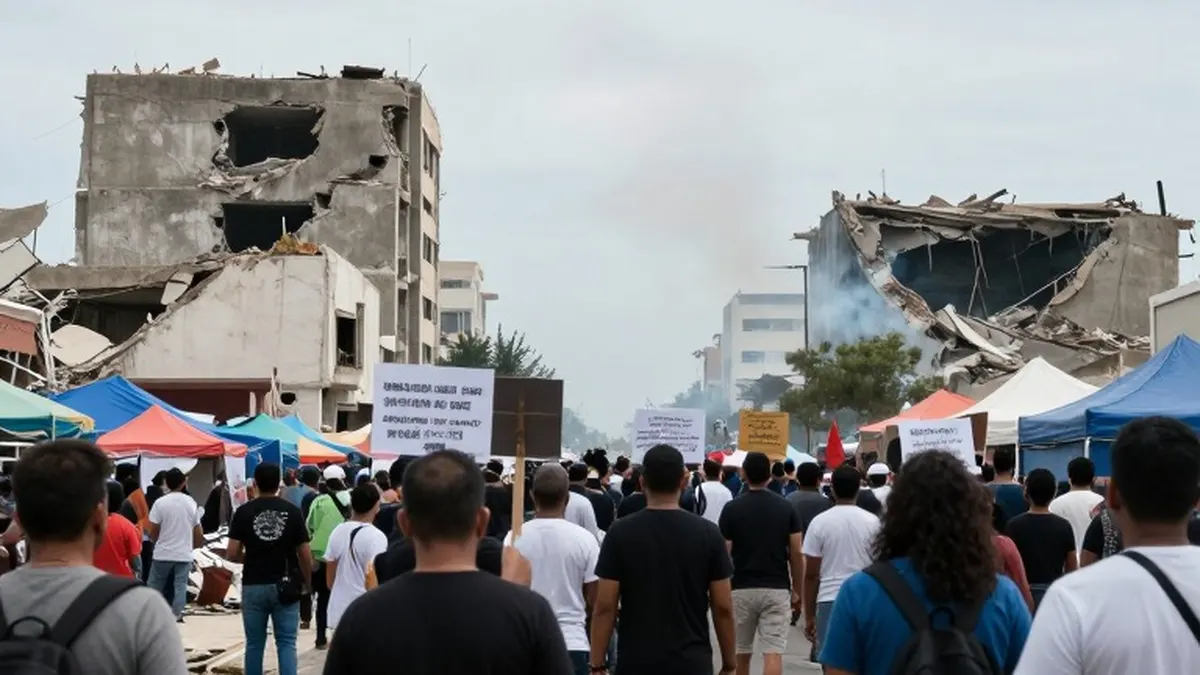
Hundreds of displaced Palestinians gathered on Saturday to protest the continued destruction of residential buildings in Gaza. The demonstration took place near the area known as the Yellow Line, a boundary that has separated Israeli and Hamas controlled zones since the ceasefire agreement signed in October 2025. The protesters were reacting to intensifying air strikes from Israeli forces, who have continued to target structures beyond the line to which they initially withdrew under the ceasefire terms.
Al Jazeera journalist Moath al-Kahlout, reporting from Deir el-Balah, described the scene as displaced residents living near the boundary line came together to voice their frustration. The Yellow Line was originally established under US President Donald Trump’s 20-point plan to end the war. While the plan called for gradual further withdrawals by Israeli forces, officials say the military has instead seized additional territory. Al-Kahlout noted that the line was located much further east in October 2025 compared to its current position.
Currently, nearly two-thirds of the Gaza Strip is either under direct Israeli army control or subject to strict access restrictions. This shift in the front line has left many residents in a precarious situation, with Israeli forces operating beyond the initial withdrawal points. The situation has led to what local officials describe as a systematic policy aimed at gradual creeping displacement, forcing residents out of their camps and destroying homes.
Mohammed Musleh, the mayor of Deir el-Balah’s Maghazi municipality, provided stark figures regarding the damage. He stated that more than 500 housing units have been destroyed in less than a month. Musleh characterized the destruction as part of a deliberate strategy to empty the camp and eliminate as much housing stock as possible. His remarks highlight the growing concern among local leaders about the pace and scope of the demolition.
Gaza’s Ministry of Public Works and Housing has reported that 350,000 families are now homeless following Israeli attacks. The ministry indicates that 80 percent of the enclave’s homes have been destroyed. In addition to the structural damage caused by strikes, recent flooding in the region has devastated temporary tent housing, further exacerbating the housing crisis for displaced families who rely on these shelters for protection.
The human toll of the continued strikes remains significant. Israeli attacks killed at least four Palestinians on Saturday. Among the victims were three individuals who died when an Israeli drone struck a van that was delivering food aid to displaced people in Gaza City. This incident underscores the risks faced by aid workers and civilians attempting to move through the conflict zone.
In the past 48 hours, Israeli strikes have killed at least nine people. According to the latest report from Gaza’s Ministry of Health, this brings the total death toll since the October 2025 ceasefire to 1,661. The ministry also reported that 55 Palestinians were wounded during the same 48-hour period, raising the total number of injured since the ceasefire began to 6,062.
Efforts to recover the dead have also been ongoing. On Saturday, Gaza’s Civil Defence announced that its crews had recovered the bodies and remains of 129 people. These remains were pulled from 39 homes and other buildings in the Nuseirat refugee camp, az-Zawayda, and Deir el-Balah in central Gaza that had been destroyed by Israeli forces. The operation concluded the second phase of a recovery project in the region, which is funded by the International Committee of the Red Cross.
Rami al-Aidi, the Civil Defence director in central Gaza, stated that 233 people have been reported missing beneath the rubble of those specific buildings. The recovery process has been lengthy, with the 53-day operation marking the end of the current phase. Al-Aidi’s comments highlight the ongoing challenge of identifying and retrieving victims from the extensive debris.
The Civil Defence agency warned in October that approximately 8,000 bodies remained under the rubble across the enclave, with about 4,000 of those in areas currently controlled by Israel. The agency cautioned that with the available equipment, the full recovery effort could take between eight and 10 years to complete. This timeline reflects the scale of the destruction and the logistical difficulties involved in clearing the sites.
Originally published by News Media House