China leads global green tech market as US lags behind, says Kerry
Former Secretary of State argues that other nations must match China’s rapid shift to low-carbon power to avoid economic loss and climate risk.
By Marco Alvarez ·
Former United States Secretary of State John Kerry stated that China has taken the lead in moving away from fossil fuels, and the rest of the world, including the United States, must now follow suit. He made these remarks as the thirty-first Conference of the Parties to the United Nations Framework Convention on Climate Change, known as Cop31, opens in Turkey.
Kerry argued that other countries are falling behind economically and increasing climate risks unless they embrace low-carbon power and rapid electrification. He noted that China is the only nation that has accelerated its efforts significantly. "The only country that has hugely accelerated is China. The rest of the world is stumbling along while Mother Nature is sending us more powerful signals every week, every day," Kerry said.
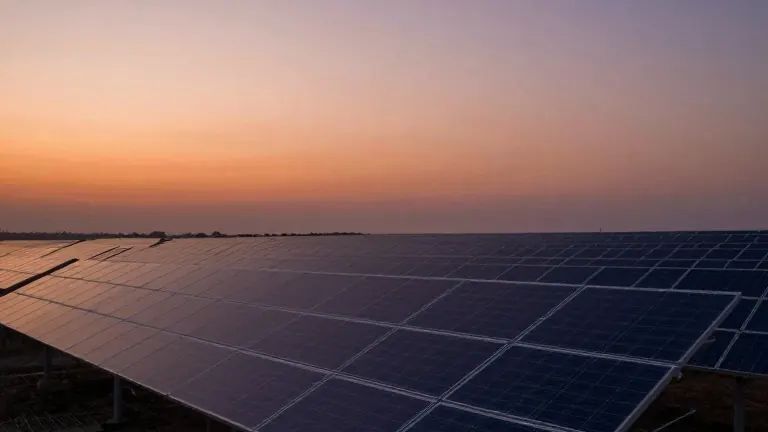
China’s dominance in the green energy sector has transformed its export economy. In 2025, clean-tech exports surpassed $220 billion, and that figure is expected to grow again this year. The country now accounts for approximately 85% of global solar production capacity and 80% of lithium-ion battery supply chain production. Nearly 75% of electric cars were manufactured in China in 2025.
Kerry attributed China’s push for independence to a realization that it had too much dependency on oil and gas from other nations. He said other countries have made similar decisions, particularly since the war in Iran interrupted the strait of Hormuz. "Thank you, Donald Trump," Kerry said, referencing the current U.S. administration's policies that have spurred a massive uptick in renewable deployment elsewhere.
Kerry suggested that autocratic states without free and fair elections will adopt low-carbon growth if they see the economic benefits China has reaped. He stated that these leaders can read a spreadsheet and understand where fossil fuel costs are high and where green alternatives offer a better deal. "Right now, renewables together with storage, together with some transitional gas, is cheaper and more effective, than just going with fossil fuels," he said.
China has expressed a desire for Cop31 to discuss the free flow of green technology against a backdrop of intensifying geopolitical conflicts. This is widely interpreted as a reference to United States and European Union tariffs on items such as Chinese electric vehicles and solar products. Li Shuo of the Asia Society Policy Institute noted that China faces the question of whether it will step into a leadership role out of self-interest rather than obligation.
Beijing views the energy transition as central to economic modernization and energy security. Kevin Tu of the Oxford Institute for Energy Studies said the wars in Ukraine and the Middle East have hardened that stance. Isabel Hilton, founder of China Dialogue, noted that the shift away from oil weakens the United States' status as the global lender of last resort. She added that China’s dominance in clean technology supply chains makes U.S. dominance look more vulnerable.
President Xi Jinping has described China as a doer and go-getter working for the cause of global development. State media frequently showcase Chinese renewable projects in countries ranging from Indonesia to Pakistan and Kenya. The value of green energy deals in China’s belt and road initiative in the first half of 2026 has already surpassed the total for the entire year of 2025.
Analysts expect China to seek support from Brazil, India, South Africa, and other developing countries that are concerned about the costs and market-access effects of climate-related trade measures. China has generally held back from policy ambition at previous forums, showing ambivalence toward global targets for electrification despite easily meeting them.
Yixian Sun, a professor of sustainability governance at the University of Bath, said there is a mismatch between Chinese policymakers’ views on their role in global climate governance and international expectations. He stated that the world must be ready to accept China’s leadership, a position he believes is not currently the case, especially in global north countries.