Trump Arrives in Manila Ahead of $3.9 Trillion Bloc Talks and Trilateral Summit
The president lands in the Philippines to join a special US-ASEAN session before heading to China for meetings with Xi Jinping and Vladimir Putin.
By Aiko Sato ·
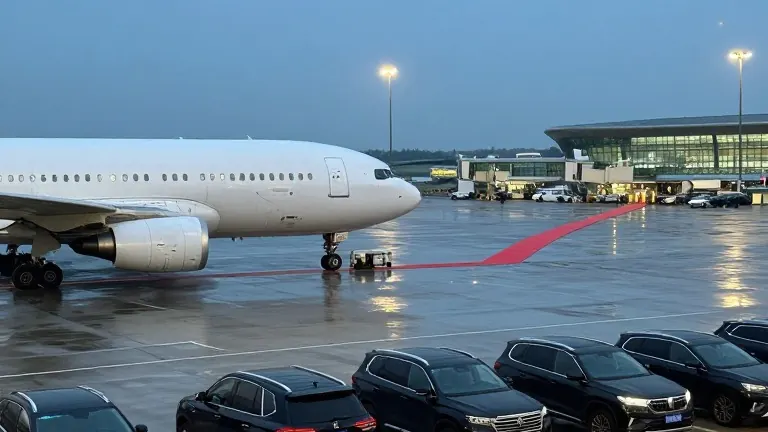
President Donald Trump arrives in the Philippines on Tuesday to conclude a regional diplomatic tour that includes high-stakes economic negotiations. The visit serves as a precursor to the Asia-Pacific Economic Cooperation forum in Shenzhen, where the US leader is scheduled to meet with Chinese President Xi Jinping and Russian President Vladimir Putin. This trilateral gathering is the final stop on a trip that also encompasses the first meeting of the Quad alliance in two years.
The timing of the Asian itinerary follows recent setbacks for the Republican Party in midterm elections and emerging allegations of espionage that threaten a fragile trade truce with Beijing. Protests have erupted in Manila in anticipation of the president's arrival. Demonstrators have burned effigies of Trump and called for the end of the Middle East conflict and the termination of the US-led Pax Silica initiative. These public displays of dissent add a layer of tension to the diplomatic agenda.
The Quad alliance, comprising the US, Japan, Australia, and India, reconvenes after a two-year hiatus. Previous administration officials viewed the group as a cornerstone of foreign policy, but it lost momentum under current leadership. Former Deputy Secretary of State Kurt Campbell attributed the reconvening to Secretary of State Marco Rubio. Campbell described the timing as the best possible signal before the trilateral talks and emphasized that the US-Japan relationship remains the linchpin of regional strategy.
White House spokesperson Olivia Wales stated that the Quad under Trump has become a partnership of action focused on tackling regional challenges. She noted that the alliance drives opportunities to ensure a free and open Indo-Pacific. Japanese officials expect the leaders to project unity on maritime security, export restrictions, and the diversification of critical mineral supply chains. Artificial intelligence is also expected to be a key discussion point.
Chinese Premier Li Qiang addressed the Association of Southeast Asian Nations on Monday, praising the economic achievements of China and ASEAN despite global trade restrictions. He urged the bloc to stand united against interference. China remains the largest trading partner for the 11-member ASEAN group, which has a combined GDP exceeding $3.9 trillion. However, the largest economies in the bloc are seeking to deepen ties with the United States amid ongoing trade and diplomatic uncertainty.
Trump will bypass the annual East Asia Summit but will participate in a US-ASEAN Special Summit. He is scheduled to meet with Philippine President Ferdinand Marcos Jr. on Wednesday. The two nations share a defense alliance that underpins US military presence in the region. Prior to his departure for the Philippines, Trump is expected to hold talks with Thai Prime Minister Anutin Charnvirakul on Tuesday.
Thai media reported that the two leaders will issue a joint statement on negotiations for a reciprocal trade agreement. The United States is the largest export market for Thailand, accounting for 24% of the country's total shipments this year. The US designated Thailand as a major non-NATO ally in 2003. The outcome of these bilateral discussions will influence the broader economic landscape of Southeast Asia as the president moves toward Shenzhen.
More Business · Consumer Alerts · Report a business · Got a Story?