Verified Small Business Loses Account to Square Without Explanation or Reason
A marketing firm provided all required documents to Square, yet the platform suspended the account and denied the appeal late, leaving the business with no clear answer for why their funds were held.
By Aiko Sato ·
A small business that helps other companies with marketing and search engine optimization followed every step required to open an account. The firm provided identification for its owners. It linked a valid bank account. It submitted the Employer Identification Number document directly from the Internal Revenue Service. It used third-party software to connect the bank account to the payment platform. It produced the documents forming its Limited Liability Company. It even had a valid contract with its client for the full amount of the money involved.
Despite these steps, the business found its account suspended.
The suspension did not happen because a document was missing. The bank account did not fail verification. The tax agency did not flag the identification number as fake. Instead, the platform enforced a rule that the business argued did not even exist as a listed reason for suspension. The business did not break a rule. The rule itself was not in the list of reasons for holding funds. But the automated system had made its decision, and it did not accept questions.
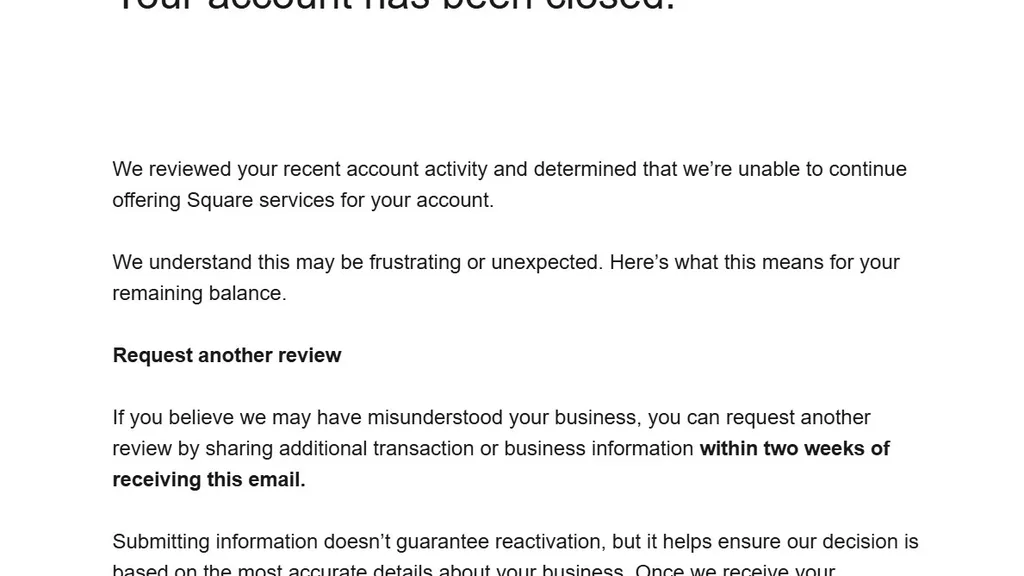
The business filed an appeal. The platform promised a response within ten days. It took two weeks. When the response finally arrived, it was a denial. There was no explanation. There was no stated reason. There was no human being to call. There was no office to walk into. There was no face to look at while the company explained why the money and the business were no longer welcome.
It was just a denial from a machine.
The business gave the platform its identity, its tax documents, its bank details, and the contract proving the client and the money were real. In return, it received a suspension with no reason and an appeal with no explanation.
This situation should anger every small business owner because the terms are written in the company's own contract. The General Terms of Service, Section 12, states that the company may terminate the terms or suspend the account at any time for any reason. The reason is optional.
Section 13, which deals with the effect of termination, says the company will not be liable to the user or any third party for compensation, reimbursement, or damages for any termination or suspension of the services. The company can take the account, hold the money, and disrupt the business, and it will not be liable.
The Payment Terms, Section 12, allow the company to defer payout or restrict access to proceeds, temporarily or indefinitely. This means the revenue, including money the client already paid, sits in the company's account while an automated system decides the fate of the business.
Section 14, regarding the reserve for holding funds, states that the company may require a reserve for any reason related to the use of the services. The amount is reasonably determined by the company itself. It is not determined by a bank, a regulator, or a judge. It is determined by the platform.
The most notable part of the story is found in Section 1 of the Payment Terms. It begins with a confession. The company states that it is not a bank. It describes itself as a payment facilitator, a processing company, and a software platform that takes payment and moves the money. It is the pipe, not the reservoir.
Yet this pipe has more power over the business than the bank that actually holds the money. A bank has to follow rules. A bank has to explain itself. A bank can be regulated. This platform is a software company with a suspension button, and that button has no off switch.
When a business tries to fight the decision, the contract is waiting. Section 22 of the General Terms forbids class actions and jury trials. It requires individual arbitration in Oakland, California. Section 19 caps the total liability of the company to the user at the fees earned from that user in the three months before the problem occurred, or five hundred dollars, whichever is greater.
Five hundred dollars is the most the business is worth to the company according to its own contract.
Section 7 adds that if there is a dispute about who owns the account, the company will be the sole arbiter of that dispute in its sole discretion. The decision will be final and binding on all parties. The company is the player, the referee, and the stadium.
This is the environment that has allowed a company that is not a bank to act like one. An automation system scrutinizes a business with zero reason and zero explanation. A merchant who did everything right, verified at every step, is suspended by a rule that was not even a reason for suspension. An appeal that took twice as long as promised dies without a word.
The business cannot easily dispute the decision because to dispute it is to arbitrate, in the company's city, under the company's rules, for a prize capped at five hundred dollars.
The platform even has a list of unsupported industries in its Payment Terms. Item six on that list is direct marketing or subscription offers or services. A marketing and search engine optimization firm is one algorithmic mood away from that list. The machine does not need the rule to be true. It needs the rule to be convenient.
There is no bank that has to explain itself in this scenario. There is no regulator that has to show its work. There is no human being who has to look the owner in the eye and say the account was suspended, and here is why.
There is only a dashboard. There is a denial. There is a machine that has never met the business, never read the contract, never spoken to the client, and has already decided.
This is not just a payment processor. It is a toll booth on the only road the business has. It is run by a company that is not a bank. It is governed by a contract that says the company can do whatever it wants, whenever it wants, for any reason, and owes the user nothing for it.
The verified business did everything right. The platform did not need it to.
That is the whole story. That is the whole system. Until a company that is not a bank starts acting like one, every small business in the country is one algorithm away from losing its money, its account, and its voice, with no reason given and no explanation owed.
The system allows for a suspension without a reason. It allows for an appeal without an explanation. It allows for a denial without a human face. The business provided the identity, the tax documents, the bank account, and the contract. It gave everything it had to prove the legitimacy of the transaction. And in return, it got a suspension with no reason and an appeal with no explanation.
The contract terms are clear. The company can terminate at any time for any reason. It can defer payout temporarily or indefinitely. It can determine the reserve amount itself. It is not liable for damages. It is not a bank. It is the sole arbiter of disputes. Its liability is capped at five hundred dollars.
The business followed the rules. It verified the account. It linked the bank. It submitted the EIN. It provided the LLC documents. It had the client contract. The machine did not care. The machine made its decision. The machine does not take questions.
The appeal was denied two weeks after the promised ten days. No explanation was offered. No human contact was available. The money remained held. The account remained suspended. The business was left to wonder if it had missed a step, if a document was unclear, if the client was questionable. But the contract said the reason was optional.
The platform is a payment facilitator. It is a processing company. It is a software platform. It is the pipe. It is not the reservoir. It is not a bank. It does not have to follow the rules of a bank. It does not have to explain itself like a bank. It does not have to be regulated like a bank.
But it has the power of a bank. It holds the money. It controls the access. It decides the fate. It does this with a suspension button that has no off switch. It does this with a contract that caps liability at five hundred dollars. It does this with a dispute resolution process that takes place in its own city, under its own rules.
The list of unsupported industries includes direct marketing. A marketing firm is close to that list. The machine does not need the rule to be true. It needs the rule to be convenient.
There is no one to ask. There is a dashboard. There is a denial. There is a machine that has never met the business. It has never read the contract. It has never spoken to the client. It has already decided.
More Business · Consumer Alerts · Report a business · Got a Story?