Rashid Johnson supervises Chicago survey
The artist spent a 24-hour visit adjusting the installation of his midcareer show at the Museum of Contemporary Art Chicago.
By Marco Alvarez ·
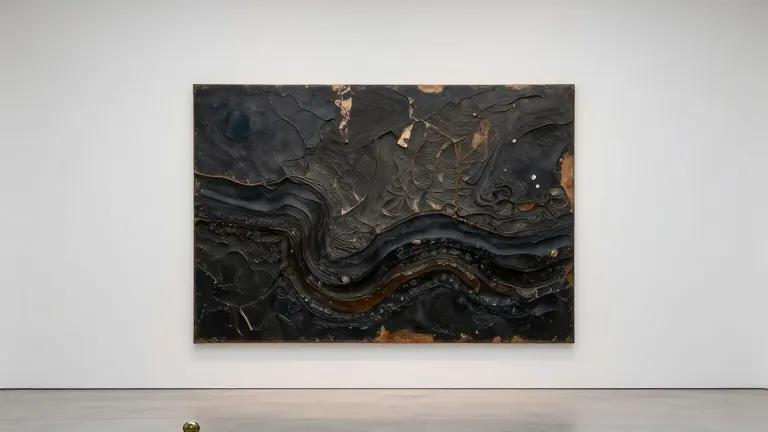
Rashid Johnson arrived in Chicago from New York City for a 24-hour visit to oversee the installation of his midcareer survey, “Rashid Johnson: A Poem for Deep Thinkers.” The exhibition opens at the Museum of Contemporary Art Chicago after premiering at the Guggenheim Museum in New York and traveling to the Modern Art Museum of Fort Worth. Johnson spent the afternoon on the museum’s fourth floor, making final adjustments to the layout of the show.
The 49-year-old artist, who was raised in Evanston, has become one of the most prominent figures in contemporary American art. His works, which often utilize materials such as shea butter, black soap, and wax, explore Black diasporic life and personal emotion. His art has sold for as much as $3 million at auction. Major institutions, including the Whitney, the Guggenheim, and the Los Angeles County Museum of Art, hold his pieces in their permanent collections.
Johnson’s career took off after he moved to New York in 2005. He gained early recognition through his photo series “Seeing in the Dark,” which featured unhoused Black men in downtown Chicago. Those images were included in “Freestyle,” a 2001 exhibition at the Studio Museum in Harlem curated by Thelma Golden. That show introduced Johnson to a wider audience alongside artists like Mark Bradford and Julie Mehretu.
Naomi Beckwith, the Guggenheim’s chief curator and one of the organizers of the current exhibition, described Johnson’s work as a remix of visual cues and personal feelings. “And he takes those references and makes work about affect, about personal feelings, and his desire to look for solace, peace, and home,” Beckwith said. “His search for safety.”
The exhibition includes works inspired by Johnson’s time spent at the Russian and Turkish Baths on Division Street. He used the sauna as a space for meditation and physical awareness, a practice that influenced series like “Anxious Men” and “Broken Men.” Jack Schneider, an assistant curator at the MCA, noted the variety of the show. “It’s almost like you’re seeing work made by several different artists,” Schneider said. “It’s like several different Rashids, just at different points in his life.”
Johnson also credited his mentor, McArthur Binion, for recognizing his potential during his time at Columbia College. Binion, an abstract painter, called Johnson’s work an “educated rawness.” Johnson said the exhibition should feel like the story of a life. “And a life, he added, looks crazy. If it looked easy to define, then it probably wouldn’t be that interesting.”
Johnson concluded his day by refining the opening salon, a dense collection of objects spanning three decades of his work. He stated that he knows when the installation is finished only when time runs out. “You know when you’re done because you don’t have any more time,” Johnson said. “It’s just the clock.”
More Culture · Chicago news · Report a business · Got a Story?