61 Seats: The Number Stalling Israel's Post-Election Government
Neither Netanyahu nor Eisenkot can assemble the parliamentary majority required to rule, leaving the Knesset in a procedural standoff.
By Andrew Hayes ·
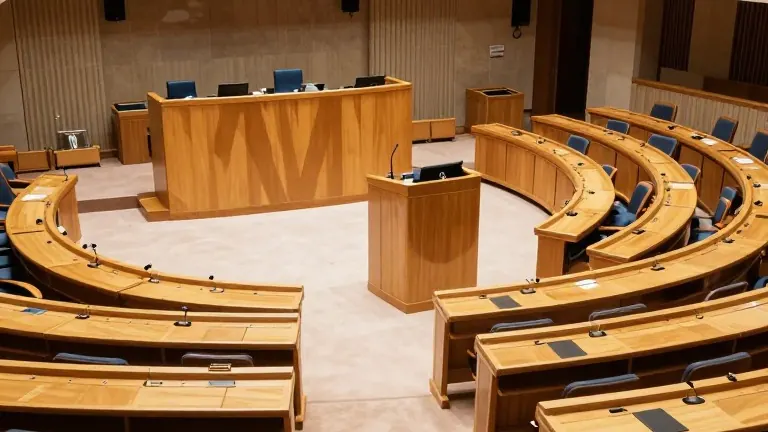
Israel’s election results have created a political impasse that prevents either major contender from immediately forming a government.
The final tallies show that opposition parties hold more seats than the bloc led by Prime Minister Benjamin Netanyahu. However, neither side has secured the 61 seats necessary for a majority in the 120-seat Knesset.
Gadi Eisenkot, a former military chief of staff, leads the opposition bloc. His parties do not have enough seats to govern without the support of predominantly Arab parties. Eisenkot and his allies repeatedly ruled out such an alliance during the campaign. Netanyahu’s Likud party received the most votes, but his coalition of right-wing, far-right, and ultra-Orthodox parties also falls short of the required majority.
In the coming days, Israel’s president will consult with leaders of all elected parties. Each party will recommend a candidate it believes can best form a coalition. The president is not bound to choose the leader of the largest party. Instead, the role goes to the candidate deemed most likely to assemble a governing majority. That candidate has 28 days to secure support from at least 61 lawmakers. The president can grant a one-time extension of 14 days.
Eisenkot appears more likely to receive the first mandate to form a government based on the election results. He is a relative newcomer to politics, but his bloc lacks a majority without Arab-led parties. Those parties represent 21% of the population. Eisenkot has stated that the Arab parties' positions on Hamas and the war in Gaza prevent him from governing with them. Some of these parties have refused to endorse the military goal of eliminating Hamas or to condemn it as a terrorist organization.
Netanyahu faces a similar arithmetic problem. His traditional coalition partners do not have enough seats to return him to power without new alignments. Several possible outcomes exist for breaking the deadlock.
One option is a unity government combining Netanyahu and Eisenkot. U.S. media reports suggest President Trump favors this outcome, though the claim has not been independently confirmed. Such a coalition would likely include moderate parties from the center and right. It could facilitate cooperation with the Trump administration on regional priorities, including Gaza reconstruction and normalization with Saudi Arabia. However, Eisenkot has pledged not to serve in a government led by Netanyahu. The two would need to resolve questions of leadership and potential rotation of the premiership.
A second possibility is an Eisenkot government supported by Arab parties. Together, they would command more than 67 seats. This remains unlikely because Eisenkot has rejected the arrangement. The Arab parties could support a minority government from outside the coalition, but that would still contradict campaign promises. A third option is another election. The president has urged leaders to avoid this path, but it remains possible if no candidate assembles a majority. Netanyahu may believe a repeat election benefits him. Arab turnout could decline if voters feel excluded from government. Liberal Israelis who traveled from overseas to vote may also be less likely to return.
A fourth possibility involves defections. Netanyahu would need roughly eight lawmakers from outside his bloc. Eisenkot would need approximately 13 defectors if he continues to exclude Arab parties. This scenario appears unlikely given current results.
The opposition can act during the stalemate. A parliamentary majority opposed to Netanyahu could advance legislation with support from Arab lawmakers. Eisenkot’s bloc is considering replacing the speaker of the Knesset. They also hope to pass a state commission of inquiry into failures preceding the Oct. 7, 2023, Hamas attack. They may also try to reverse legislation that critics say weakened democratic institutions. These steps would allow opponents to exercise power while negotiations continue.
A renewed war with Iran could disrupt these plans. Netanyahu said Israel must complete its mission against Iran to remove an existential threat. Eisenkot warned Netanyahu not to use security for political needs. An emergency could increase pressure for a unity government. Danny Citrinowicz, an Israeli analyst, said Netanyahu has an incentive to renew fighting while a government is being formed. He stated that an emergency would mount pressure on Eisenkot to enter a unity arrangement.